
AI that empowers the CFO rather than replacing one.
Sherpa is an AI financial analyst built for a practice rather than for one company. It reads every client’s books in real time and drafts the work you would otherwise start from a blank page. Then it hands you something you can check.
I run a fractional CFO practice on this software, and I wrote the software. What follows is what I let a model do with real clients’ books, and what I do not.
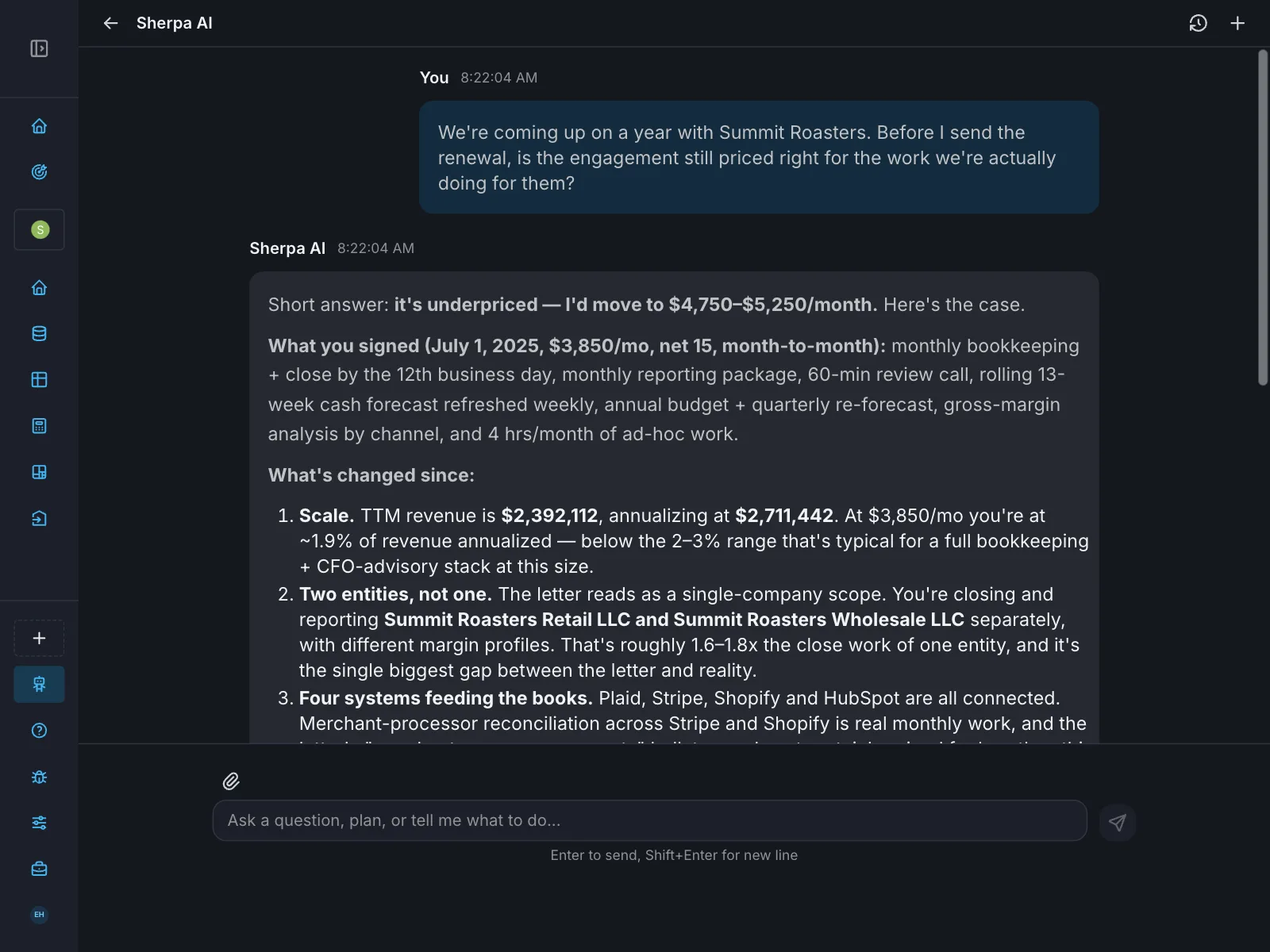
Empower the practitioner. Do not try to replace them.
The question worth asking is which parts of your week AI should be anywhere near. Both lists below are short. Being honest about the second one is what makes the first one worth believing.
What it is good at
- Pattern recognition
- The vendor whose coding quietly changed in March. The cost that shows up in two places. The thing a person finds on a good day and misses on a Thursday.
- Analysis
- Compare every period and every client at once. You had time for three.
- Classification
- Coding against years of a client’s own history, at a volume nobody sustains by hand.
- Reconciliation
- Matching, tying out, and finding the item that does not belong.
- Sounding plausible
- Listed here on purpose. It is very good at this, which is the problem the rest of this page deals with.
What it is not as good at
- Recognizing its own blind spots
- It does not know what it does not know. Hand it an incomplete picture and it answers anyway, fluently and with confidence. Mid-close, incomplete is the normal state.
- Discernment
- Knowing which of two defensible treatments is the right one here, for this business, this year. That is not in the transaction.
- Relating to clients
- The call where you read the room and decide how hard to push. That is the job.
- Representing you
- Standing behind the number. Being the person a lender, a board or an auditor can ask. It cannot do that, and it will never be asked to.
Notice which column sounding plausible sits in. It is a real strength, and it is why a finance tool needs something better than trust. The last section on this page is about that.
What it actually does, specifically.
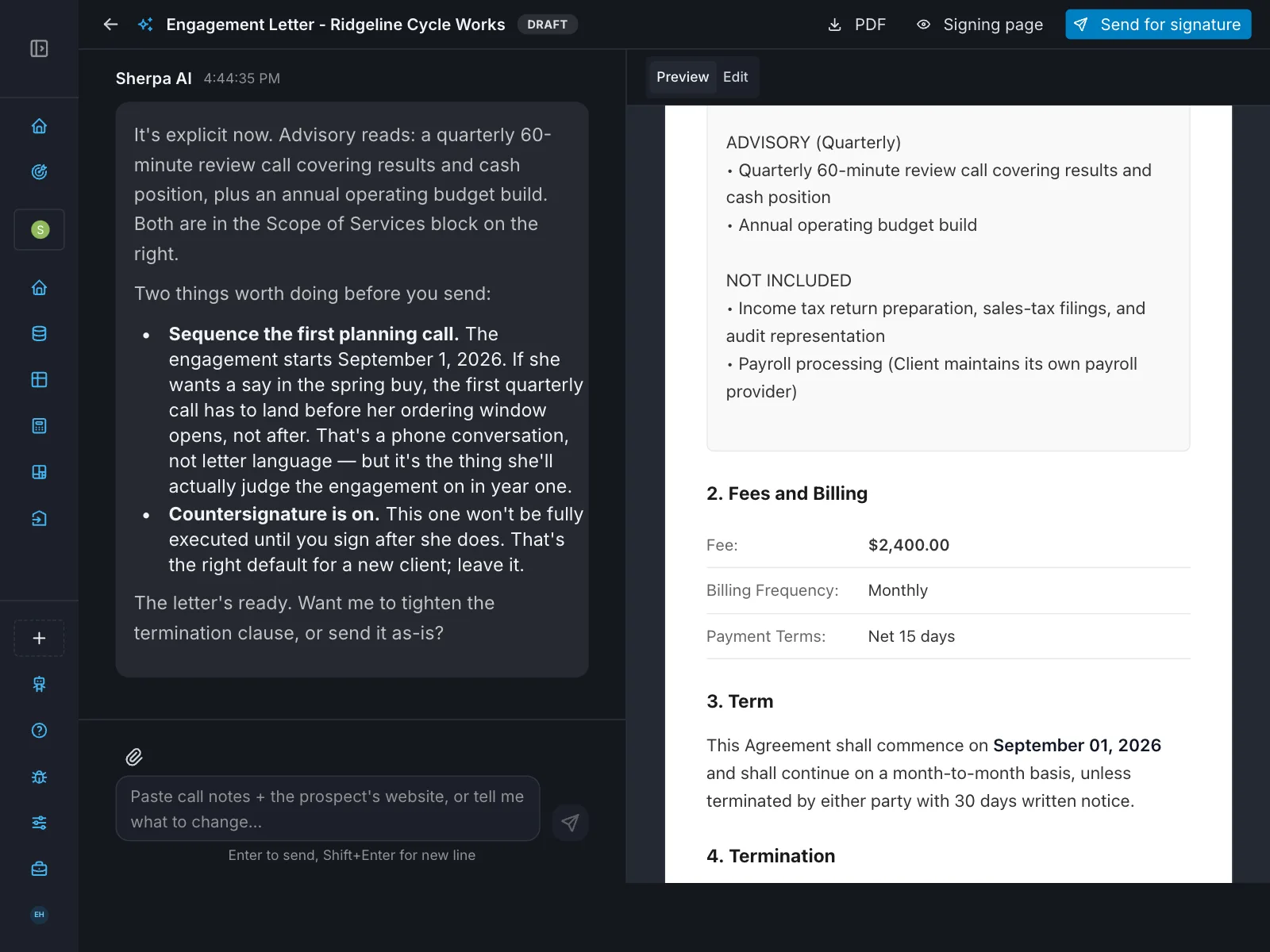
- Draft proposals from meeting notes
- It already has the notes, the prospect record and the pipeline. The proposal and engagement letter come out of what you actually discussed.
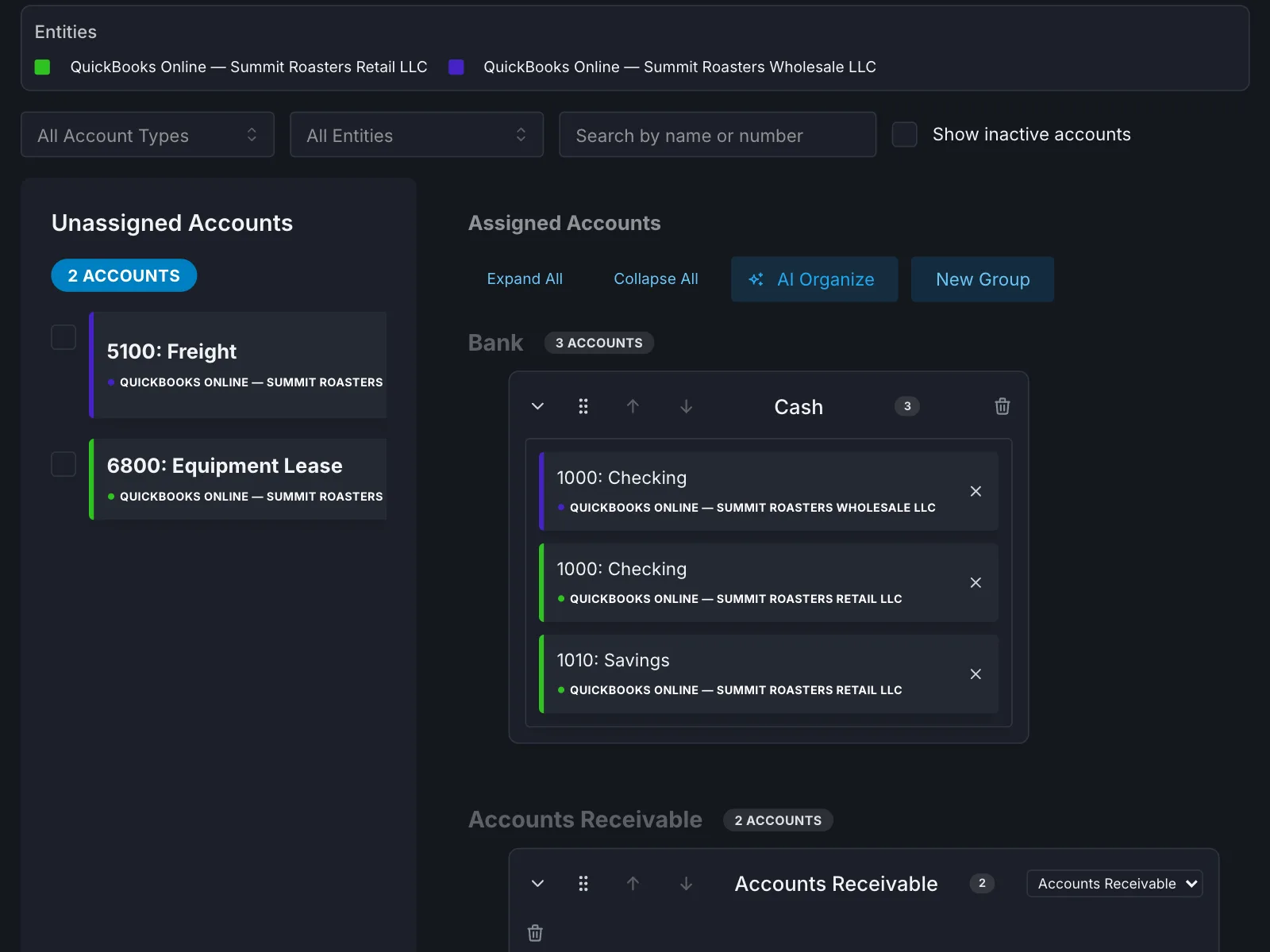
- Map and organize a chart of accounts
- The job that makes a new client take a week. It proposes the mapping against your standard structure, and you correct it.
- Analyze the financial statements
- Ask what moved and why, against the actual ledger, for one client or across the whole roster. The answer traces back to the transactions it came from.
- Build forecast elements
- Drivers, schedules and the components of a three-statement model, assembled from what the books already show.
- Assemble the dashboard and the monthly package
- Built around what a particular client actually watches. Under your brand, on your subdomain.
- Draft the management discussion and analysis
- The narrative section nobody wants to start at 10pm. It writes the first version off the real numbers; you make it say what you mean.
Each of these is covered in more depth elsewhere: the analyst in detail, how the platform fits together, and how access is scoped.
Sherpa, or the model you already pay for. Or both.
Most tools in this market give you their assistant and a wall around it. Alpyne assumes you already have a model you like, a history you have built up in it, and opinions about how you want to work.
Sherpa, built in
Alpyne’s analyst with the full context of a client already loaded. Nothing to set up and nothing to connect.
Or your own, over MCP
Point Claude or ChatGPT at your Alpyne data and work there instead, with your subscription, your prompts, and the history you have already built up. Same permissions either way.
In the app, or in your spreadsheet
Your workbook is not the problem and nobody is asking you to abandon it. Work with Sherpa against the sheet you already trust, with the data arriving on its own.
MCP stopped being a differentiator in 2026. Several tools in this market ship one, DataRails among them. What differs is what a model can reach once connected, which is the next section.
All of it, all the time.
The common way a fractional CFO uses AI today is to export a client’s financials and paste them into a chat window. That is stale the second it happens, it does not survive a follow-up question, and it leaves a client’s books in a history nobody controls. Alpyne never needs the copy to exist.
- Every client’s live data, continuously. Not a point-in-time extract. The books as they are right now, conformed to the same structure across your whole roster, so one question can be asked of all of them at once.
- The whole history, not just the ledger. Correspondence, the engagement and its scope, meeting notes, proposals, open to-dos. The reason a number moved is very often in an email from February rather than in the general ledger.
- Financial principles, market and macro context. It is not working on a set of books in a vacuum. The treatment and the outside conditions are part of what it reasons inside.
That is the difference between an assistant and an empowered one, and it is structural. A tool bolted to a proposals system can only ever see proposals, no matter how good its model is. The same argument, made against named products, is on the comparison pages.
All of it sits inside the same per-client permissions as everything else, and any of it can be switched off, per client, at any time. How access is scoped and enforced →
Double-entry is a five-hundred-year-old system for catching plausible nonsense.
Every vendor is asking you to trust their AI. I would rather you verified it, the way you verify everything else that touches a set of books. A trial balance does not care whether a human or a model made the entry. It tests the result, not the reasoning, and fluency is what it is immune to. So the controls are the shape of the product.
- The principles are in the context
- The accounting treatment, the structure of the statements and the rules that govern them are part of what it works inside. Its answers argue in the terms you would use.
- Parity and balance checks
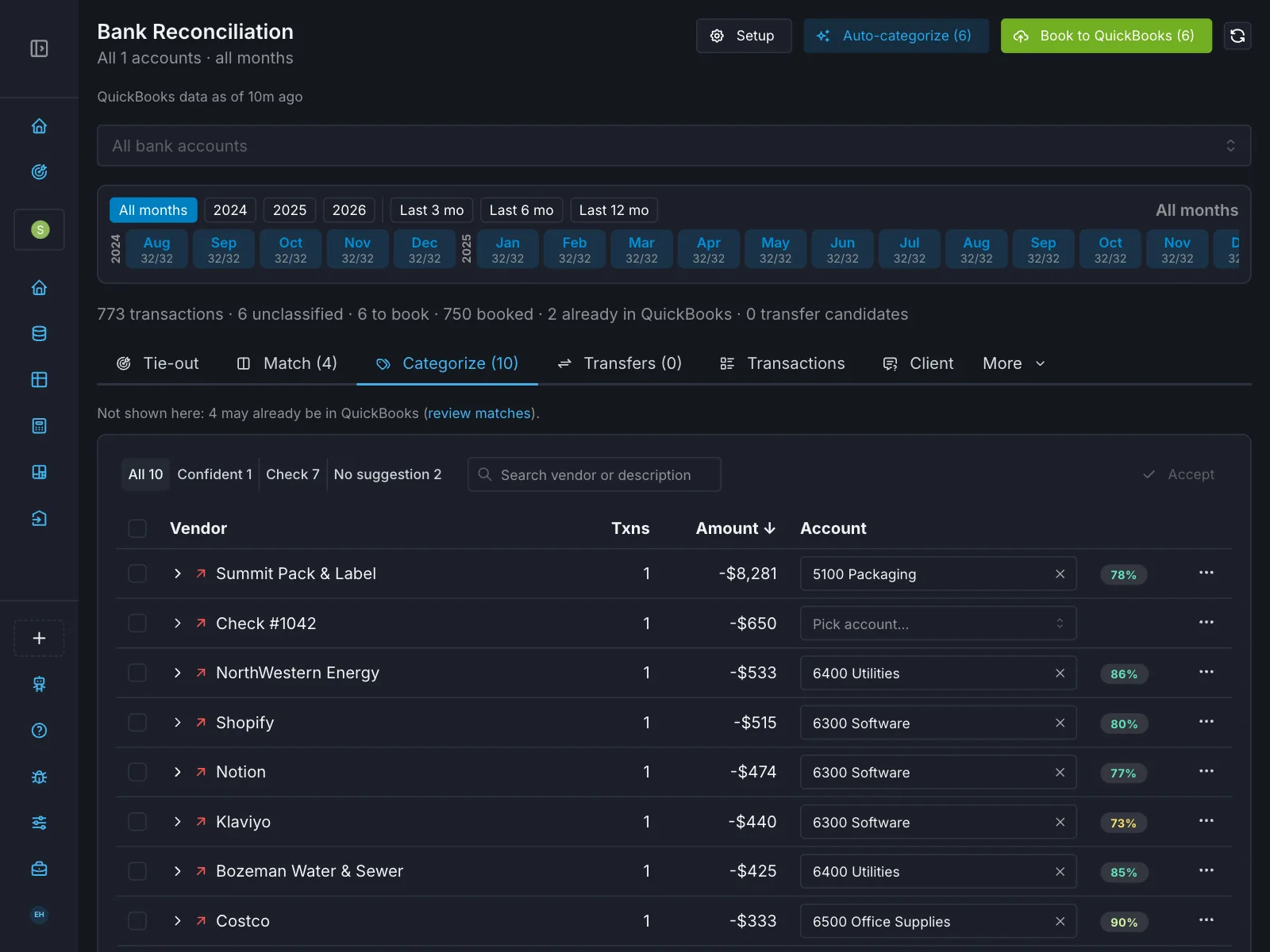
- The balance sheet balances or it does not. Cash reconciles or it does not. A plausible wrong answer fails a tie-out the same way a careless one does.
- Enforced verification
- Suggested categorizations, reclassifications and journal entries arrive as proposals carrying a confidence score, and nothing reaches the ledger until a person accepts it. Low-confidence items are separated out rather than folded into a bulk-accept.
- A change log that names names
- Every applied write records what changed, when, and who approved it. The entries and the person, not “AI updated 13 transactions”. If a client’s auditor asks how a reclass happened eight months ago, there is an answer.
And four things it does not get to decide.
The right-hand column at the top of this page is a specification. Here is what it comes to in practice.
- Anything that turns on intent. Whether a cost was meant to be capitalized or expensed is not in the transaction.
- Estimates, accruals and reserves. Judgment encoded as a number. It can show you the history. It does not pick the figure that goes in front of a lender.
- The call you would put your name to. Forecast assumptions, going-concern language, anything a board will act on.
- What to actually tell a client. It drafts the note. You decide the message and whether it goes.
The pattern throughout is that AI drafts and the CFO decides. That is where the leverage comes from, and it is the position you are in anyway. You are personally accountable for the numbers you put your name to, and “the AI did it” is not a defence to a client, a lender or a board. The accountability never moved. The data handling did.
Questions people actually ask
- What is an AI financial analyst?
An assistant that answers questions about a company’s financial data, surfaces what moved between periods, and drafts the first version of the analysis. In Alpyne it is grounded in each client’s actual conformed ledger rather than in a model’s general training, and the answers trace back to the transactions they came from, so you can check one before it reaches a client.
The useful version of this is narrower than the marketing suggests. It does the lookup and the drafting. The interpretation, and the decision about what any of it means, stays with the person who signs the work.
- Should a fractional CFO use AI on client books?
Yes, for the pattern work, and with controls. Categorizing against years of history, reconciling, surfacing variances and drafting commentary are all things a model does well and does not get bored doing. That is most of what makes a close long.
The part worth being careful about is not the technology, it is the interface between a confident answer and a set of books. A model does not know what it does not know, so it needs checks that test the result rather than the reasoning — tie-outs, reconciliations, approval before anything posts, and an audit trail. Those are the controls accounting already has. Use them and the leverage is real. Skip them and you are relying on something that is very good at sounding right.
- Can I turn the AI off?
Yes, per client. AI features and ledger write access are two separate switches, set individually for every client. You can run one client with both on and the next with both off, or allow AI analysis while blocking any write to the books.
Nothing is all-or-nothing at the account level, because the client who is relaxed about this and the client whose board is not are usually in the same practice. If a client’s engagement letter says no AI, that is a setting, not a reason to leave the platform.
The full security overview →- Does it read my email?
Only if you connect it. Email is an optional integration, not part of the default setup, and everything else on this page works whether a mailbox is connected or not.
Connect one and it reads that correspondence alongside the meeting notes, proposals and open to-dos already in Alpyne, under the same per-client permissions as everything else. Decide this one deliberately. A mailbox holds more than financial data, and the honest trade is that the context improves the analysis while widening what the assistant can see.
How access is scoped →- Is my clients’ data used to train AI models?
No. Alpyne’s AI runs on Anthropic’s commercial Claude API, and under Anthropic’s commercial terms customer data sent through the API is not used to train its models. Client data is not sent to any other AI vendor.
- What stops it seeing a client it shouldn’t?
The same thing that stops a person seeing one. The assistant works inside the same access checks as the rest of the platform. It can only see the client data the signed-in user is already authorized to view, and the server checks that on every request. For AI-generated data queries each company sits in its own database schema, queries are validated against a list of allowed tables, run read-only, and carry strict time and row limits.
The full security overview →- Can it send email to my clients?
It drafts. You read it and decide whether it goes, the same way every suggested ledger change is a proposal until a person accepts it. There is no mode where a model corresponds with your client while you are not looking.
- What if I want to use my own model instead of Sherpa?
Then use your own. Alpyne ships an MCP server, so Claude, ChatGPT or any MCP client can work against your Alpyne data directly, with your own chat history, prompts and subscription. It runs inside the same permissions as everything else. Connecting a model does not widen what it can see.
One platform user wired ChatGPT to Alpyne this way and uses it to build summary, working-capital and revenue-forecast tabs on top of his models. That was not a feature I planned for him; it is what happens when the door is open.
- Is Alpyne SOC 2 certified?
No, and I will not imply otherwise. The controls are built to the principles those frameworks expect and the infrastructure underneath is independently audited, but Alpyne itself does not hold the certification. If that is a hard requirement for one of your clients, it is worth raising before a trial rather than after.
What is in place, and what is not →
Turn it on for one client and judge it yourself.
Both switches are per client, so start with the books you know best and check the suggestions against what you would have done. That is the only test worth running.