
Sherpa, your AI financial analyst
The problem is not analysis you cannot do. You are a CFO; of course you can. It is the twenty-minute lookup, twelve times a day, across nine clients. Each one is trivial. The sum of them is why the strategic work keeps sliding to the evening.
Sherpa takes the sum off your plate while leaving every individual answer checkable. You ask in plain language, it answers from the client’s real conformed data, and the answer traces back to the transactions it came from.
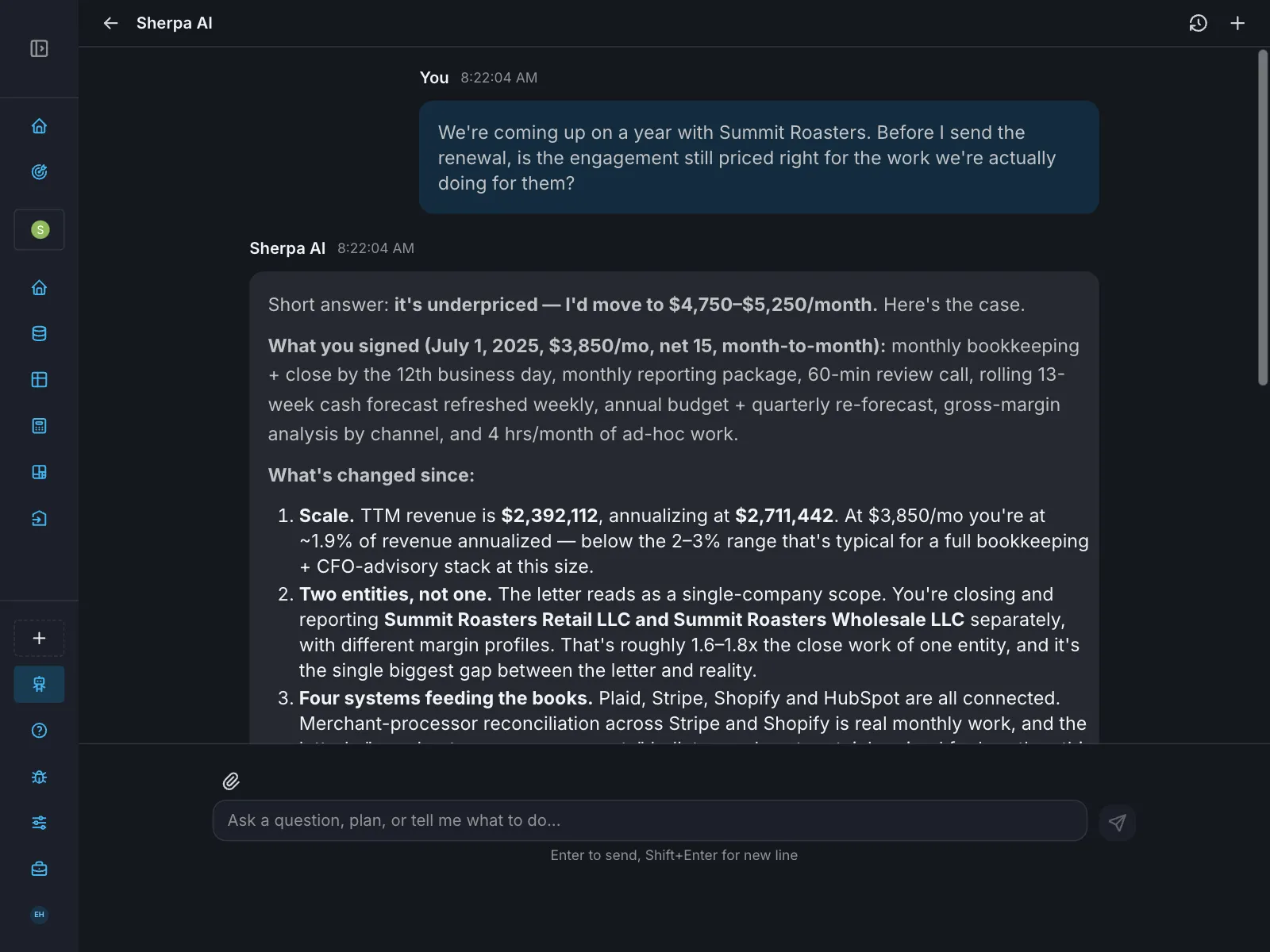
Three steps, and the first one is the one that matters.
- 01
Conform
Each client’s books are mapped to one standard structure, so a question means the same thing for every client.
- 02
Ask
Plain English, against live data rather than a snapshot you pasted somewhere.
- 03
Check
Trace the answer back to the transactions. Nothing reaches a client without you.
Conforming is first because everything above it depends on each client’s books meaning the same thing. How the layers fit together →
The parts, specifically.
- Ask questions against any client’s data
- Natural-language queries against any connected client’s conformed financials. No query language, no export step. “Why did gross margin dip in March?” and “Which clients grew revenue this quarter?” are the same kind of question to it.
- Variance analysis and first-pass commentary
- Period over period and budget versus actual, with drafted commentary on what moved. You edit a narrative rather than starting one from a blank page.
- Grounded, and traceable
- Every answer traces back to the underlying data, so you can verify a number before it reaches a client. An analyst you can audit is useful. One you have to take on faith is not.
- It works across the roster
- The same plain question runs against your whole book, because underneath, every client’s data speaks the same language. This is the part a single-company tool structurally cannot do.
Questions people ask
- What is an AI financial analyst?
An assistant that answers questions about financial data, surfaces variances and drafts analysis. In Alpyne it is grounded in each client’s actual conformed numbers rather than a general model’s training data, and the answers trace back to source.
- Can AI do variance analysis for finance?
It can do the surfacing and the first draft: identifying what moved between periods or against budget, and drafting commentary. The interpretation, why it matters and what to do about it, remains the CFO’s work.
- Is Sherpa ever wrong?
Any model can be. That is why checkability is the design rather than a disclaimer: answers trace to the underlying data, suggested ledger changes carry a confidence score, and nothing posts without approval. Treat it like a fast junior analyst — useful, and always verified.
- Can I turn it off?
Yes, per client. AI features and ledger write access are two separate switches, set individually for every client. If a client’s engagement letter says no AI, that is a setting rather than a reason to leave the platform.
Next: What it is not allowed to decide · How access is scoped · The platform overview
Try it on one client.
Connect the books you know best and judge it against what you would have done yourself.
Start a 14-day trial