
Run and scale your practice from one place.
Manage every client, add your team, and ship recurring deliverables without juggling logins or rebuilding the same reports each month. Grow the book without growing the hours.
Practice management starts with naming the capacity ceiling.
Every fractional CFO practice hits the same wall, and it is almost never a demand problem.
- More clients should not mean more late nights
- Each new engagement is good revenue and bad maths. Another login, another chart of accounts to decode, another month-end stacked on the pile. The tenth client does not take a tenth of your attention. It takes roughly what the first one took, because nothing about the work compounds.
- Practices stall at capacity, not demand
- Ask a practitioner at eight clients why they are not at twelve and the answer is never "no pipeline". It is hours. When every client’s data lives somewhere different and every deliverable is rebuilt by hand, billable capacity is a hard ceiling and the only lever is turning work away.
- The tax repeats every month
- You do not set a client up once. You re-export, re-map and re-assemble their numbers every close. Hiring does not fix it either; a new analyst inherits the same workflow. It is a systems problem, which is why it does not respond to working harder.
Manage every client from one roster
- One view of the whole book
- Every client side by side: cash, close status, open deliverables. One screen answers the question that used to take twelve logins.
- Conformed and current
- Each client’s systems connected once and their chart of accounts mapped to one standard structure. A single source of truth per client, comparable across the roster.
- No more juggling logins
- Client systems stay where they are. You and your team work in Alpyne, and the browser full of tabs and the password spreadsheet go away.
Add your team and assign them to clients
- Assign per engagement
- Add an analyst, a controller or a contract bookkeeper and give them exactly the clients they serve. Everyone knows their book; you keep the full-roster view.
- No shared client credentials
- Your team gets access through Alpyne rather than through the client’s QuickBooks login. Nobody is emailing credentials, and nobody who leaves keeps a password.
Standardize what you ship, every month
- Build a deliverable once, reuse it
- Design your monthly reporting package or board report one time, then run it for every engagement. Because the data is conformed, the package that works for client three works for client eleven.
- The same standard every close
- Every client gets the same professional output regardless of who on your team ships it. Consistency is what lets a practice carry your name rather than your fingerprints.
- Feed the spreadsheets you already use
- Alpyne does not replace Excel or Google Sheets. It feeds them, on a schedule, with numbers you did not retype.
Onboard a new client without losing a week
- Connect their systems in one click
- New engagement signed? Connect their QuickBooks or Xero and Alpyne pulls and conforms the books. No export project, no waiting on their bookkeeper’s schedule.
- Reuse your templates on day one
- Your reporting package, your model, your close checklist, already built. A new client onboards onto your playbook rather than onto a blank spreadsheet.
- Win the work first
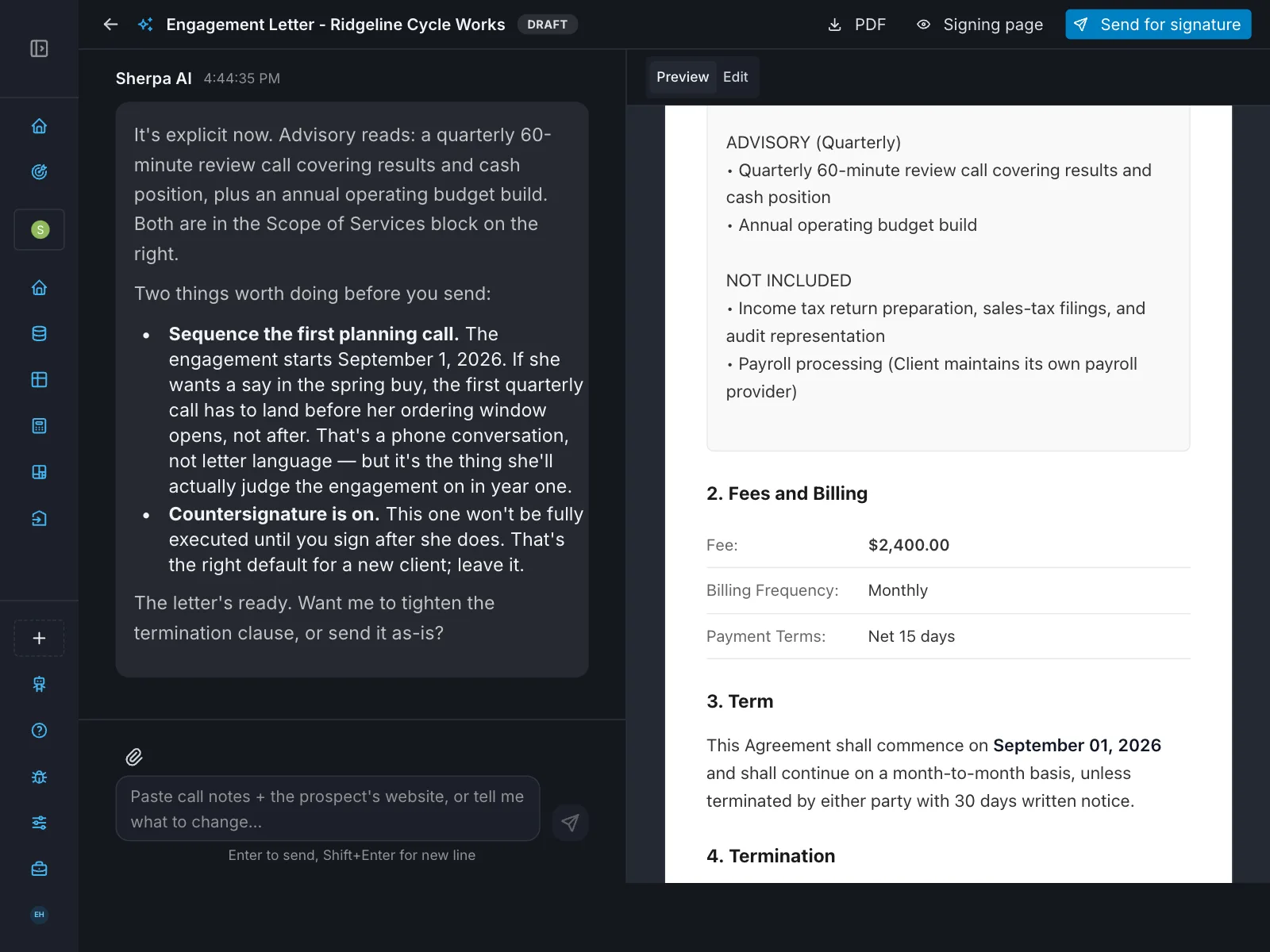
- The front of the engagement is here too: pipeline, AI-drafted proposals and engagement letters off your meeting notes, e-signature, then recurring billing.
Take on more clients with the same team.
When conforming, reporting and delivery run on the system, each additional client costs a fraction of what it used to. The ceiling moves, and the revenue you have been turning away stops walking past.
The hours you get back are the highest-value ones in the practice: the forecasting conversations, the board prep, the hard calls. That is the work clients renew for, and the work that grows a practice’s reputation rather than just its client count.
Alpyne was built by a fractional CFO who hit this exact ceiling before writing a line of the platform. This is not a use case somebody imagined. About Bryan →
Questions people ask
- What is practice management software for fractional CFOs?
Software that runs the operational side of a multi-client CFO practice: every client’s data in one place, team members assigned to engagements, and deliverables standardized and shipped on schedule. Alpyne combines all three with the data layer underneath — one-click integrations and a conformed chart of accounts — which generic workflow tools do not have.
- How many clients can I run?
As many as you run. Each client is priced at one of three levels, the bill is the sum, and the whole bill is discounted at 5 and again at 10 clients. Past 25 clients the Enterprise plan is priced for the practice instead. Your own firm’s books do not use a seat.
- Can I add team members and control what they see?
Yes. Add staff or contractors and assign them to exactly the clients they serve, so access is scoped per engagement and nobody needs the client’s own accounting credentials.
- Can I standardize deliverables across clients?
That is the point of conforming the data first. Build a reporting package or recurring deliverable once and run it across every client, because each client’s books have been mapped to the same structure. Without that step, every "template" is a rebuild.
- Does this replace my CRM?
For the practice, generally yes. Pipeline, contacts, meeting notes and to-dos are in Alpyne, alongside proposals, engagement letters and billing. The reason to have them in the same place as the numbers is that the AI can then see both, which is how it can tell you an engagement is underpriced.
Run a real close through it.
Connect a client or two, ship a month-end close in Alpyne, and judge it against your own hours. That is the only test worth running.
Start a 14-day trial