Alpyne
Built by a CFO, for fractional CFOs

The Operating System for Your Fractional CFO Practice

One system for the whole engagement — win the client, connect their books, close the month, build the model, deliver it under your brand. Alpyne connects QuickBooks, Xero, NetSuite and more in one click, then runs your practice on top of them.

14-day free trial · No long-term contract · From $199/month

Looking to hire a fractional CFO rather than buy software? That is the other half of what I do →

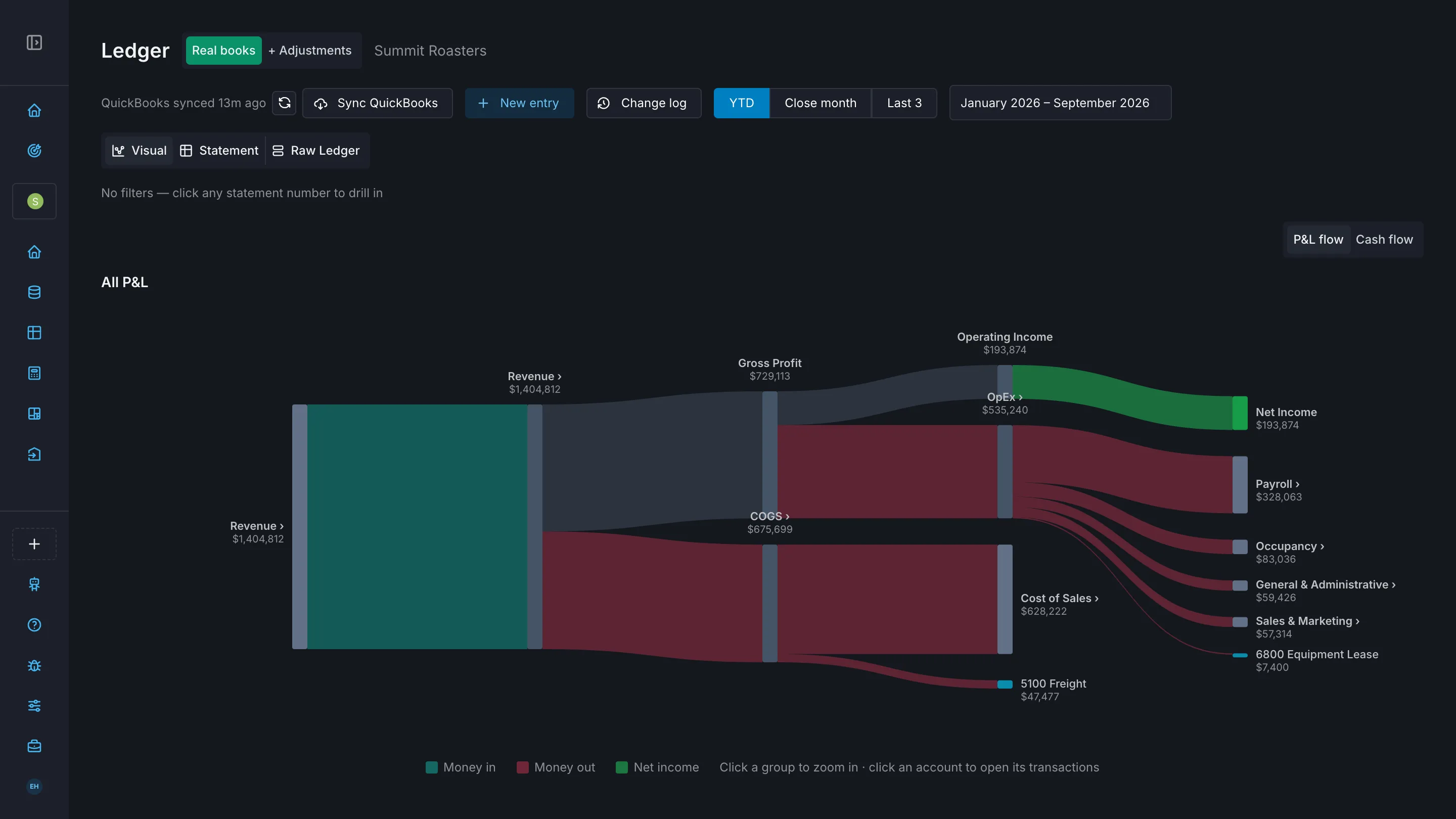
The Alpyne ledger view for a client, showing a flow diagram of the profit and loss: revenue of $1,404,812 splitting into cost of goods sold and gross profit, then into operating expenses and $193,874 of net income, with payroll, occupancy and other accounts broken out on the right.
A client’s whole P&L as a flow. Click any band to zoom in; click an account to open its transactions.

Month-End Shouldn’t Take All Month

You didn’t build a fractional CFO practice to spend your evenings downloading CSVs. But that’s what running six, eight, twelve clients has quietly turned into — and every new engagement makes it worse.

01

Every client is on a different system

One client runs QuickBooks Online. Another is on Xero. The one you just signed is mid-migration to NetSuite, with revenue data trapped in a billing system and a chart of accounts that follows no logic you’d recognize. None of it matches, so before you can advise anyone, you spend hours making the data merely comparable.
02

You’re the bottleneck at every month-end close

Closing the month for seven clients at once means seven logins, seven trial balance exports, seven versions of the same report rebuilt by hand. Your clients wait on you, your team waits on you, and the work that only you can do — the strategy, the forecasting conversations, the hard calls — waits longest of all.

03

The manual work is crowding out the advisory work

Nobody hires a fractional CFO for data entry. They hire you for judgment. Yet the general ledger wrangling, the reconciliations, and the copy-paste reporting eat the hours your judgment should fill. That’s not just exhausting — it’s a cap on how many clients your practice can hold.

What changes

What a practice looks like on the other side of it.

Take on more clients without hiring

The ceiling on a practice is the owner’s hours, and most of those hours go into handling data rather than advising anyone. Move that work and the same person carries a bigger book — the ninth client stops costing a weekend.

Stop moving data by hand

No more exporting, reshaping and re-keying between a client’s systems and your workbook. Alpyne pulls from the systems your clients already run, conforms it, and keeps it current — so the first hour of the month is analysis rather than assembly.

Keep the clients you win

A client who logs in to their own live dashboard, whose board pack comes from your system, whose month-end runs on your process, does not shop around. The output is what makes an engagement sticky, and sticky engagements are the difference between a practice and a pipeline.

Win the work you’d otherwise lose

Buyers compare. When the other firm shows up with a live portal, AI-assisted close and reporting that updates itself, a monthly PDF built in Excel reads as a firm standing still. This is what being the modern option looks like in a bake-off.

Fractional CFO Software That Puts Every Client in One Place

Alpyne is a finance operating system built for one user: the fractional CFO running a multi-client practice. Not a corporate FP&A suite with a “fractional” tab bolted on — a platform designed around the way your practice actually works.

One-click integrations with your clients’ systems

Connect QuickBooks, Xero, NetSuite, Stripe, Salesforce, HubSpot, Shopify, Chargebee, Zoho, Copper and Google Analytics & Ads directly. No exports, no middleware projects, no waiting on a client’s bookkeeper.

Every client’s data, conformed and standardized

Alpyne pulls each client’s books and conforms every client’s data into a clean, standardized structure — mismatched charts of accounts mapped, GAAP-consistent categories applied — so a report you build once works for every engagement.

From a dozen logins to a single source of truth

Open one dashboard and see every client’s position: cash, runway, variances, whatever you track. Month-end close stops being twelve separate fire drills and becomes one workflow you run across the portfolio. When a client calls with a question, the answer is a click away — not an export away.

  • QuickBooks
  • Xero
  • NetSuite
  • Stripe
  • Salesforce
  • HubSpot
  • Shopify
  • Chargebee
  • Zoho
  • Copper
  • Google Analytics & Ads
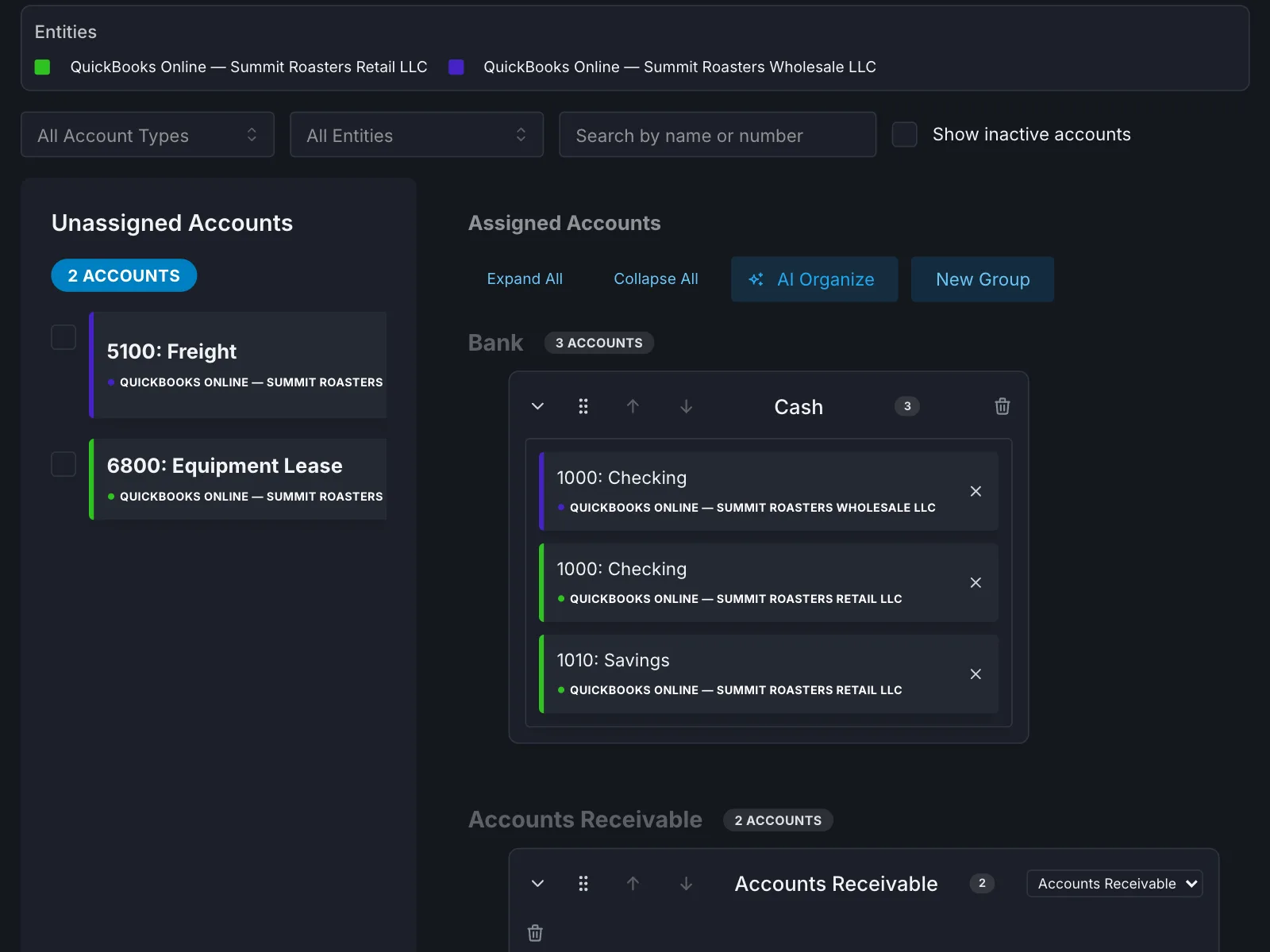
Alpyne's chart of accounts mapping screen. Two QuickBooks Online entities — Summit Roasters Retail LLC and Summit Roasters Wholesale LLC — are colour-coded, with unassigned accounts on the left and both entities' checking and savings accounts grouped together under a single Cash heading on the right.
Two entities, two charts of accounts, one structure. Colour marks which entity each account came from.
Start your free 14-day trial

Run Your Whole Practice in One Platform

The data problem is only half the job. The other half is the practice itself — winning the client, scoping the work, billing it, and staffing it. Alpyne runs that half too, instead of leaving it stitched together from a CRM, a proposal tool, a billing tool and a password spreadsheet.

Track prospects through to signed

A pipeline built for an advisory practice rather than a sales team. Who you are talking to, what was scoped, what it is worth, and what happens next — in the same system that will run the engagement once it is won.

Draft engagement letters with AI, send them for signature

Paste your call notes and the prospect’s website and get back a scoped engagement letter — services, exclusions, fee, terms — that you edit rather than start. E-signature and countersignature are built in, and the signed scope stays attached to the client, so the work you agreed to is still visible at renewal.

Bill your clients from the same place you serve them

Recurring fees, one-off project work and the invoice itself, running off the engagement you already scoped. No second system to reconcile against.

Add your team and assign them to clients

Bring on an analyst or a controller and assign them to exactly the clients they serve. Role-based access means everyone sees what they should — and nothing they shouldn’t.

Collaborate without sharing client logins

No more emailing QuickBooks credentials or maintaining a password spreadsheet you’d rather your clients never see. Your team works inside Alpyne; the client systems stay locked down.

Standardize deliverables across every engagement

Build your monthly reporting package, board deck inputs, or KPI review once — then run it as a recurring deliverable for every client. New engagements onboard onto your playbook, not a blank page.

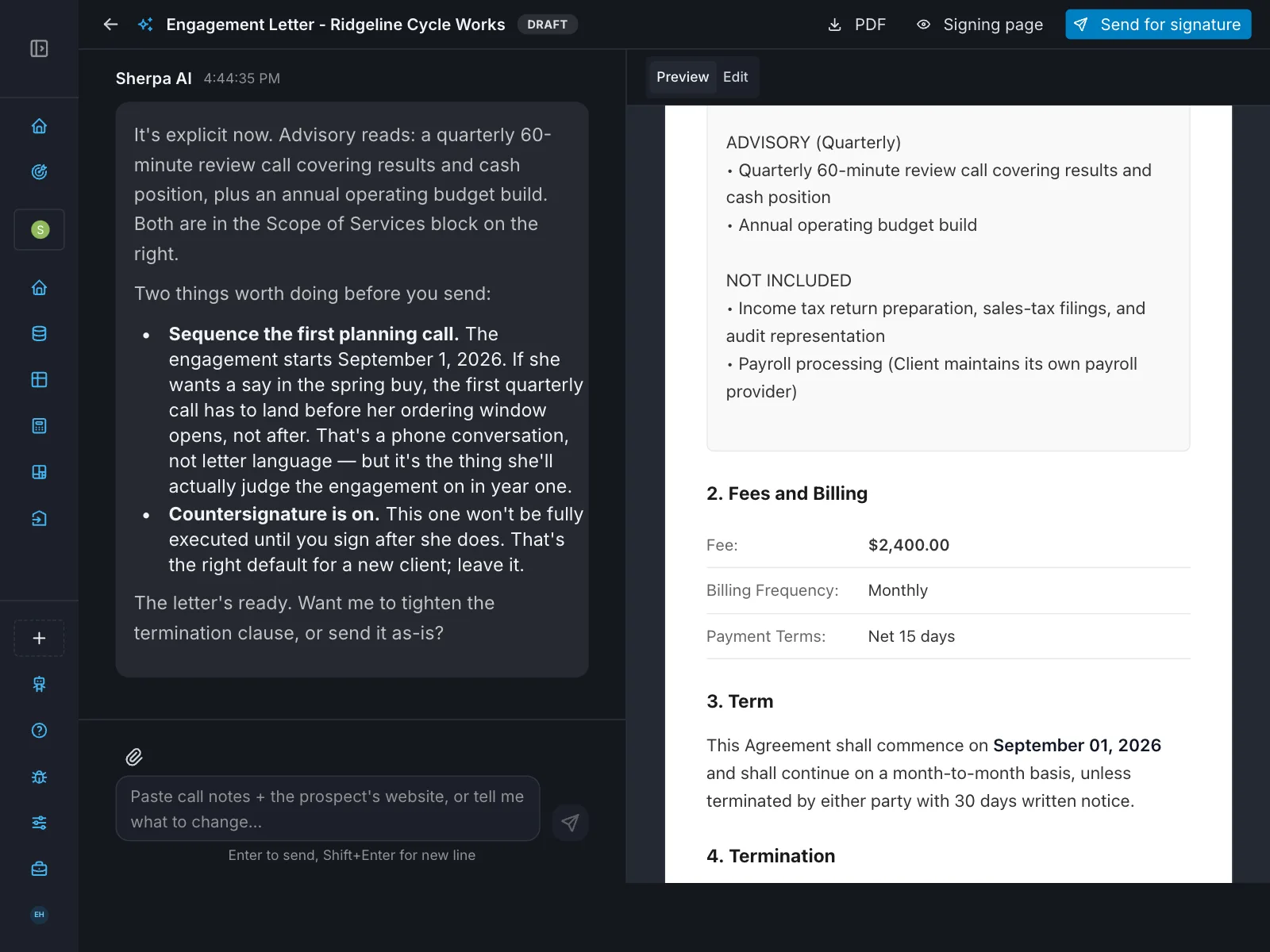
An engagement letter for Ridgeline Cycle Works in draft, with Sherpa AI in the left pane advising on sequencing the first planning call and leaving countersignature on, and the letter preview on the right showing scope, a $2,400 monthly fee and net 15 terms.
Engagement letters drafted, reviewed and sent for signature in the same place the work happens.

The Numbers: Reporting, Forecasts, and an AI Analyst

A practice OS is only as good as the output it produces. Alpyne handles the FP&A layer your clients see.

Dashboards you can share with clients and investors

Live, presentable dashboards for each client — cash, P&L, KPIs, variance analysis, balance sheet reconciliation status — clean enough to put in front of a founder or a board without rebuilding anything in slides. Budget vs. actuals update as the books do, so the version your client sees is never a month stale.

Rolling forecasts and driver-based models

Build rolling forecasts and driver-based models on top of conformed data instead of fragile spreadsheet links. Update the drivers; the forecast follows.

Meet Sherpa, your AI analyst

Ask questions of any client’s data in plain English — “why did gross margin dip in March?” — and get answers grounded in the actual ledger, not a hallucinated summary.

Sync any data to any spreadsheet, on any schedule

Alpyne doesn’t replace Excel or Google Sheets — it feeds them. Push conformed, up-to-date client data to any workbook on a schedule you set, so the models you’ve spent a career refining finally run on data you trust.

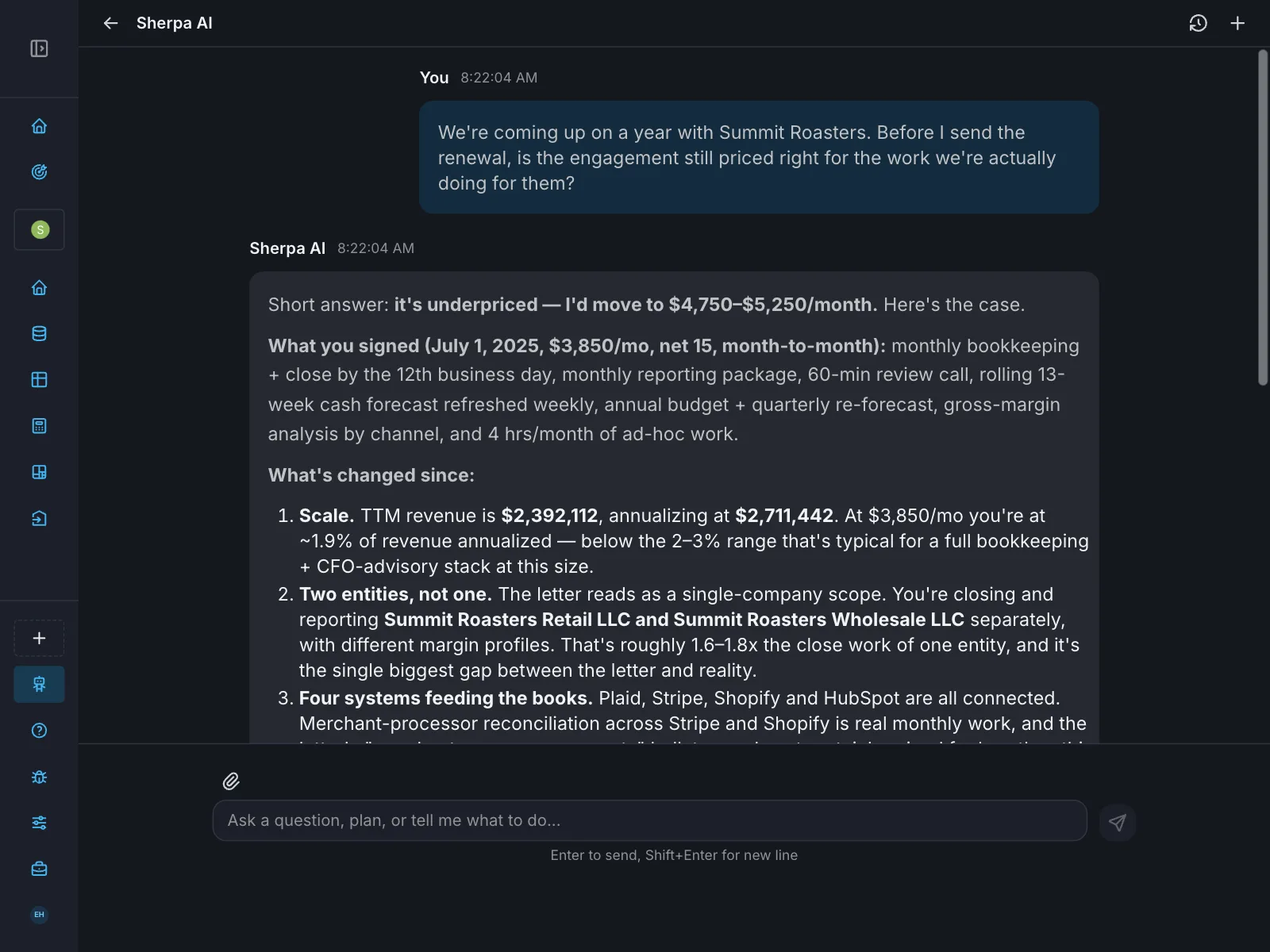
Sherpa AI answering the question of whether an engagement is still priced correctly. It concludes the work is underpriced and recommends $4,750–$5,250 a month, citing the signed scope, trailing twelve month revenue of $2,392,112, the fact that two entities are being closed rather than one, and four connected systems feeding the books.
A question that crosses the engagement letter, the ledger and the entity structure at once. No single-purpose tool can answer it.

Built by a Fractional CFO Who Got Tired of the Manual Work

Independent Fractional CFOs

Alpyne was built by a fractional CFO — Bryan McGowan, a veteran CFO with an engineering background, a Cornell MBA, and years at Intel — who ran the same multi-client grind you do and decided to build his way out of it. He didn’t just spec the platform; he writes the integrations. When a CFO who can code builds finance software, it works the way finance actually works.

Not a horizontal FP&A tool with a “fractional” tab

The big FP&A platforms sell to in-house finance teams first; fractional CFOs are a landing page. Alpyne is the opposite: the entire platform — data conforming, multi-client views, team assignment, recurring deliverables — exists for the practitioner. You’re not the segment. You’re the whole point.

Transparent pricing, no enterprise sales gauntlet

No “book a call to see pricing.” No procurement theater. See transparent pricing, start a trial, and decide for yourself — the way you’d want your own clients to be able to buy.

Get started for free

Transparent Pricing. Free for 14 Days.

Simple, transparent pricing that scales with your practice.

See the price before you talk to anyone

Alpyne publishes its pricing right on the site. Evaluate it against what your manual hours cost you and make the call yourself.

Start free, cancel anytime

14 days, full platform, no long-term contract. Connect a couple of clients, run one month-end through Alpyne, and see how much of your close disappears. Don’t spend another month-end exporting trial balances.

Most practices

Standard

Fractional, outsourced and advisory firms

$199/month

Includes 2 clients · up to 9 · $812/mo at full house


Inside

In-house finance teams running one company

$199/month

1 company


Enterprise

Practices running ten or more clients

Custom

Unlimited clients · ten or more

See the full pricing table
The other half

I did not build this from a product spec.

I run a fractional CFO practice. Alpyne is the software it runs on, and every feature on this page exists because something in my own month was taking too long. The close, the reclassifications, the board pack, the proposal written at 11pm.

That is also why a second kind of visitor ends up here. Some of you are not shopping for software at all — you run a company whose finance function has been outgrown, and you are looking for a person.

Run Your CFO Practice on One Platform

Stop letting manual administrative chaos cap your advisory firm’s growth. Replace fragmented spreadsheets, automate complex forecasting, and deliver investor-ready reporting in a few clicks.

Reclaim your unbillable hours and shift your focus to high-leverage strategy with the first true AI financial operating system.

Start your free trial
Or read the pricing first — every figure is published

Frequently Asked Questions

What is Alpyne?

Alpyne is fractional CFO software — a finance operating system that connects every client’s accounting and revenue systems, conforms their data into one standardized structure, and gives you one platform to run reporting, forecasting, your team, and your deliverables across the whole practice.

Who is Alpyne for?

Fractional CFOs, outsourced CFOs, virtual CFOs, and controllers running multiple clients — typically 6 to 12 — each on a different back-office stack. If you serve many companies and none of their systems match, Alpyne was built for you.

It also fits accounting and bookkeeping firms moving into advisory and CAS work. If you already hold the books and want to sell forecasting, board reporting and CFO-level advice on top of them, the hard part is doing it repeatably across a client base — which is the part Alpyne does.

In-house finance teams running a single company can use it too, on the Inside plan.

Which systems does Alpyne connect to?

Accounting and ERP: QuickBooks, Xero, NetSuite and Zoho — these are the ledgers Alpyne reads from and, where you enable it, writes back to.

Beyond the ledger: Stripe, Salesforce, HubSpot, Shopify, Chargebee, Copper and Google Analytics & Ads. These are what turn a P&L into unit economics — revenue by channel, customer acquisition cost, retention — the numbers a client actually asks about.

Bank and card feeds come through Plaid, read-only. There is also two-way sync to Excel and Google Sheets, so the models you have spent a career refining keep working.

How is Alpyne different from a general FP&A platform?

General FP&A platforms are built for a single in-house finance team; multi-client work is an afterthought. Alpyne is built for the practitioner: multi-client data conforming, team-to-client assignment, and standardized recurring deliverables are the core of the product, not a tab.

The bigger difference is span. FP&A tools model the numbers and stop. Alpyne covers the whole engagement — pipeline, AI-drafted engagement letters and billing at the front; reconciliation and AI-assisted ledger work that writes back to QuickBooks and Xero in the middle; modelling, forecasting and white-labeled client reporting at the end. No FP&A platform touches a proposal or a ledger.

Is my clients’ data secure?

Access is per client: a user sees a client only if their firm assigned them to it, and the server checks that on every request. AI features and ledger write access are two separate switches, set individually for each client — so you can run one client with both on and the next with both off. Nothing posts to a client’s books without a person approving it, and every write is logged with what changed and who approved it.

Alpyne is not SOC 2 certified, and we say so rather than implying otherwise. The full detail — hosting, encryption, what each integration can and cannot do, how the AI is scoped — is on the security page.

Read the security overview →

How much does Alpyne cost? Is there a free trial?

Pricing is published on the pricing page — no demo required to see it. Plans start at $199/month including 2 clients, and the per-client rate steps down as you add more. Every plan starts with a free 14-day trial and no long-term contract.